
What is Composable Commerce?A Guide for Modern Retail Leaders
What happens when your system architecture is the very thing that stops you from adopting evolving commerce technologies easily and quickly?
For businesses running legacy architectures, upgrades often mean slow deployment cycles, difficulty breaking vendor lock-in, or even production downtime. A composable commerce architecture reduces your dependence on a rigid, single-vendor tech stack.
It lets you build one in which your preferred best-of-breed commerce technologies can integrate and scale independently within your system. This means you can have the best Product Information Management (PIM), Enterprise Resource Planning (ERP), or Order Management System (OMS) tools and replace or upgrade them as needed. However, these advantages come with nuances.
This article breaks down composable commerce. At the end, you will have a good grasp of what it is, its anatomy, its business benefits, its trade-offs, whether you should use it, and how to get started.
Defining Composable Commerce
Composable commerce is an architectural pattern in which e-commerce domains are isolated as individual business capabilities and flexibly combined to form a customized platform. Domains such as the frontend presentation, product information management (PIM), payment processing, and backend order orchestration operate as decoupled components.
This allows you to choose the exact tools that best represent each component to run e-commerce operations optimally. For example, this could mean picking Shopify for storefronts, Stripe for Payment Service Provider (PSP), Hantera_ for order orchestration, Business Central for ERP, and Zendesk for Customer Experience (CX). Each of these platforms would operate independently while still communicating and exchanging data via APIs and events to function as a single e-commerce unit.
Composable commerce differs from traditional systems, where all commerce functionality lives in an all-in-one system, with components closely dependent on each other. It is also distinct from headless commerce, which decouples only the frontend storefront while leaving the core commerce platform tightly bound.
Traditional vs. Headless vs. Composable: What Is the Difference?
The table below contrasts composable commerce, headless setups, and traditional commerce architectures across key operational dimensions.
| Architectural Dimension | Traditional Commerce | Headless Commerce | Composable Commerce |
|---|---|---|---|
| Core Architecture | All-in-one suite where presentation, business logic, and database share one codebase. | Decoupled frontend communicating via API to a single unified backend commerce engine. | Ecosystem of independent business domains and specialized platforms, built using a modular approach. |
| Decoupling Scope | Zero decoupling across frontend or backend layers. | Presentation layer only (web, mobile, or Point of Sale (POS) storefronts). | Multi-domain; presentation, PIM, search, OMS, and ledger operate as separate capabilities. |
| Release Velocity | Slow; changes require full-system builds and extensive regression testing. | Fast for UI changes; backend features remain bound to the core system’s release cycles. | Fast; teams deploy independently within each domain context. |
| Failure Blast Radius | High; a failure in one part of the platform can affect other parts of the system. | Moderate; frontend and backend are decoupled, but backend failures can still affect core commerce operations. | Lower; failures in one domain can be isolated from adjacent operations. |
| Vendor Dependency | High single-vendor dependency across most business functions. | Single core backend vendor paired with a custom or third-party frontend framework. | Modular vendor ownership; capabilities can be upgraded or swapped without replatforming the suite. |
The Anatomy of a Composable Architecture
For an architecture to be considered composable, its components should be domain-aligned, communicative, and easily interchangeable. The two most important pillars for achieving this architecture are self-containment and communication.
Gartner’s concept of packaged business capabilities (PBCs) captures self-containment: single, independent software modules that manage a specific business functionality. APIs, events, or messaging systems provide the integration capabilities these modules need to communicate.
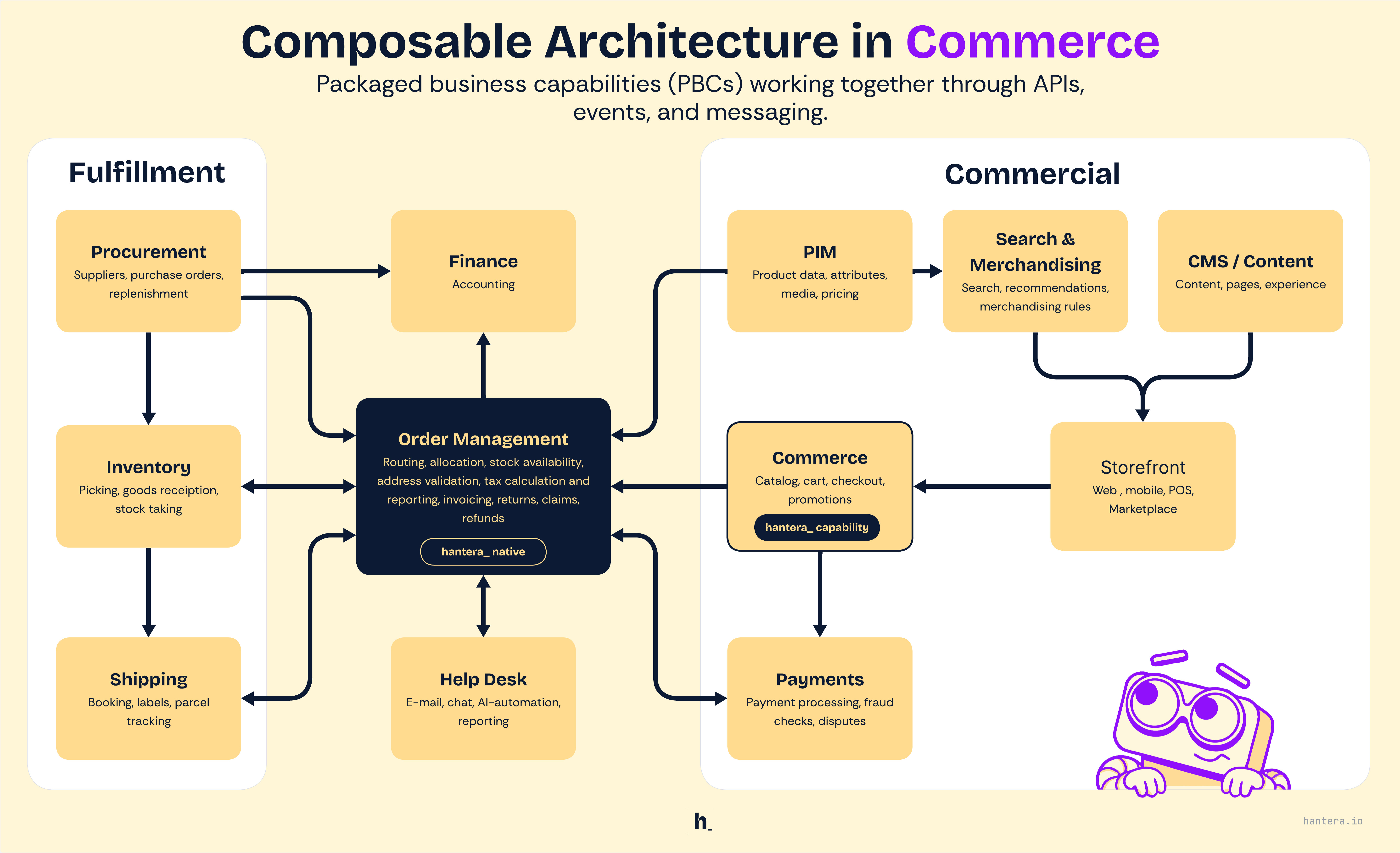
When implemented properly, a composable architecture exhibits four core principles:
- Modularity: It is decomposed into distinct capabilities.
- Interoperability: The capabilities must expose interfaces to interact with other systems.
- Replaceability: Individual capabilities can be swapped for alternatives that can fill the same roles without needing a full system rebuild.
- Flexibility/Adaptability: The structure allows capabilities to be recombined, extended, or scaled as needs evolve.
While microservices architecture is one way to achieve this, event-driven and modular monolithic architectures can also support composability. The core idea is to structure your system to adopt these composable commerce principles.
The Business Benefits of Composable Commerce
Here are some of the upsides of adopting composable commerce.
Accelerated Time-to-Market & Continuous Evolution
Once the architecture is established, adding a new feature or upgrading an underperforming one takes less time because changes don’t directly alter existing core system configurations. Teams can make these changes without tying configurations together, verifying that new setups can access the same shared data, and running massive regression tests to ensure deployments don’t break adjacent services. It also permits dedicated teams to deploy capabilities in parallel. As a result, ideas move faster from the drawing board to production, and the business can keep up with evolving commerce innovations.
Decoupled Read Traffic for Improved Performance
In an all-in-one suite, customer browsing, search filtering, and checkout can compete for the same database connections and compute resources. This can degrade the responsiveness of customer-facing interfaces. A composable architecture lets you isolate product discovery and browsing on dedicated read engines. This avoids resource contention with write-heavy transactional operations, keeps storefront pages responsive even under heavy traffic, and improves page speed. That matters commercially because faster pages can directly influence conversion and order value. Deloitte Digital’s Milliseconds Make Millions study found that a 100ms improvement in mobile speed was associated with an 8.4% lift in conversions and a 9.2% increase in average order value.
Minimized Vendor Lock-In
The tools you use directly affect how quickly payments reconcile, how warehouses update inventory, and how efficiently orders route. When a single lagging tool or feature affects your operational effectiveness, a decoupled stack lets you swap or upgrade that capability. Adopting composable commerce keeps you from getting stuck with a single vendor’s closed roadmap or relying on a single suite for every commerce operation.
Efficient Omnichannel Execution Across Channels
Composable commerce works well for omnichannel retail execution. Because communication happens via APIs and events, backend services can expose unified inventory and order data across multiple frontend channels. For example, an OMS can aggregate pooled inventory data across distribution centers, physical retail shelves, and third-party logistics (3PLs) as orders are created or returns are processed.
Composable commerce gives your teams more options and flexibility. You aren’t locked into a single technology, and you can experiment without the friction of stretched, high-risk deployment processes. Implementing it, however, introduces distinct operational challenges worth considering.
The Trade-offs of Going Down the Composable Route
While the composable commerce approach offers numerous advantages, it also comes with a few usage and maintenance complexities. Let’s discuss some of them.
The Integration & Observability Overhead
The APIs or messaging layers that allow components to interact within the architecture require proper configuration and oversight. First, if each chosen component has a distinct data model, you may need a middleware to map and translate payloads between them.
In a decoupled stack, webhooks can fail silently, endpoints can throw 504 gateway timeouts, third-party rate limits can throttle message ingestion, and system states can become eventually consistent. You must build your system to expect and reconcile such eventualities. You have to build and implement layers such as dead-letter queues (DLQs), automated retry policies with exponential backoff, and idempotency checks to prevent duplicate charges or duplicate order fulfillment. You also need distributed tracing and observability tools to follow an order’s state as it moves across the various components.
Multiple Vendor Governance
Adopting multiple systems means your team has to manage multiple vendor lifecycles optimally. They have to track varying Service Level Agreements (SLAs), system upgrades, and changing vendor policies. This becomes more challenging when those changes do not happen on a schedule. An unannounced schema change or rate-limit shift can create unintended operational blockers. You need to keep track of changes across each vendor’s ecosystem while running your core operations.
IT and Workforce Overhead
While composable commerce is sometimes presented as a plug-and-play solution that reduces reliance on IT, it still demands specialized engineering expertise to set up and maintain. A team must handle API authentication handshakes, periodic token rotations, CI/CD automation, and schema migrations across services. Without experienced developers to govern these integration contracts, organizations risk data drift, security vulnerabilities, or pipeline failures.
Total Cost of Ownership (TCO) & Contract Multiplicity
While composable commerce eliminates the capital- and workforce-intensive cost of replatforming your workflows during upgrades, its operational expenses can escalate quickly. Typically, you deal with multiple software licenses and recurring contracts across Content Management System (CMS), search, PIM, PSP, OMS, and cloud infrastructure. Moreover, many modern platforms bill on consumption metrics like API call volume, bandwidth, or order throughput. An unexpected spike in bot traffic or recursive webhook loops can trigger overage charges.
Use these trade-offs as part of your considerations when trying to decide whether you should adopt composable commerce or not.
When to Stick with an All-in-One Suite vs. When to Go Composable
Not every business needs to adopt composable commerce just because it is an industry trend. For some, adopting it is complete overkill when you weigh the integration overhead against its real utility. Here is an honest breakdown of when an all-in-one suite suffices and when it makes operational sense to go composable.
Stick with an All-In-One Suite if you:
- Rely on single-node fulfillment, such as a single central warehouse or one dedicated 3PL.
- Run a small team and lack dedicated in-house engineers to manage APIs, tokens, CI/CD pipelines, and monitoring across multiple vendors.
- Manage a standard Direct-to-Consumer (D2C) model with simple checkout flows, flat pricing, and catalog requirements that do not require extensive custom development or ERP workarounds.
- Find that the cumulative cost and management overhead of running separate Software as a Service (SaaS) contracts outweigh the operational benefits.
Adopt Composable Commerce if you:
- Are constantly running into platform limits while trying to deploy modern, competitive customer experiences.
- Run complex, multi-node fulfillment involving regional distribution centers, physical retail stores (Buy Online, Pick Up In Store (BOPIS)/ship-from-store), third-party dropshippers, or international hubs requiring near-real-time inventory visibility and reservation across nodes.
- Manage hybrid Business-to-Business (B2B) and Business-to-Consumer (B2C) operations with customer-specific pricing, quote-to-order workflows, cross-border tax rules, and multi-currency transactions that exceed out-of-the-box checkout capabilities.
- Have (or plan to scale) multiple independent engineering and digital teams whose deployment velocity is constantly bottlenecked by a centralized, shared release pipeline.
If you decide that composable commerce is the right fit for your business, the next question is: how do you get started?
How to Get Started with Composable Commerce
Below is a step-by-step, low-risk approach to getting started with a composable commerce migration.
Step 1: Pinpoint your core domains and primary constraints
Split your existing e-commerce operations into business capabilities such as presentation, product catalog, checkout, order management, and content management. Audit each capability to identify which ones are primary growth barriers or operational bottlenecks. For example, your team could be limited by slow mobile page loads and rigid frontend templates, or held back by inventory sync failures, manual order routing, and ERP database locks.
Step 2: Decide on a Migration Strategy
Determine whether your business can tolerate a complete switchover or if an incremental, phased approach is safer. If you prefer a phased approach, start by decoupling the domain identified as your primary bottleneck.
Step 3: Assess Best-of-Breed Tooling
For each domain you plan to migrate, evaluate available composable commerce solutions and tooling options. Determine where to adopt established, market-tested SaaS platforms and where your business needs demand a custom-built solution.
Step 4: Design the Interaction and Integration Layer
Map out how your domains will communicate without creating tight dependencies between them. This might be through simple API integrations or via dedicated middleware, such as API gateways or webhook routers. Also, implement translation layers so that systems with different data models can ingest, translate, and process schemas without data corruption.
Step 5: Test Integrations and Implement Observability
Before decommissioning any existing workflow, rigorously test the new integrations using methods such as unit, contract, and end-to-end automated testing. Layer in distributed tracing and monitoring early so you can detect dropped webhooks, payload errors, or latency spikes.
Final Considerations for a Composable Commerce Platform
Composable commerce lets you build your technical stack from the ground up with your preferred tools, while keeping the flexibility to swap them out when they no longer serve your business needs. As you have seen, it comes with a few trade-offs, but those shouldn’t be a blocker if your diagnostic evaluations point to a composable model.
Remember to always start by identifying the domains causing your primary operational pain. If that turns out to be order management and fulfillment orchestration, Hantera_ solves that problem really well. The platform also supports both headless and composable setups. Its app framework lets you plug in native prebuilt applications or build custom business logic across capabilities like multi-node inventory routing, payment capture, and return processing. You can build a complete headless backend while allowing Hantera_ to connect and coordinate communication with multiple vendors in a composable setup.
Frequently Asked Questions
What is the difference between a Packaged Business Capability (PBC) and a Microservice?
A microservice is a small, independent unit of a larger software application focusing on a single task, e.g., generating an invoice or calculating sales tax. It is one of the architectures that support composability. A PBC is a business capability that packages multiple related services, data models, and logic into a single unit. For example, an order orchestration engine that encompasses a sales tax service, an invoice service, and an inventory routing service.
Can a monolithic architecture support composable commerce?
Yes. A modular monolithic architecture can support composability as long as it enforces domain boundaries and avoids tight internal coupling. You can achieve this by structuring your system into distinct, self-contained modules that communicate via internal interfaces or APIs rather than tangled database queries.
What engineering skill sets are needed to maintain a composable stack?
To maintain a composable stack, you need:
- Integration and backend engineering for managing APIs, middleware orchestration, and event-driven architecture.
- Modern frontend engineering for headless storefronts and reusable UI component development.
- Cloud and DevOps engineering for CI/CD automation, observability, and cloud infrastructure management.