What Is Omnichannel Retail?And Why Order Orchestration Is Its Real Engine
It sounds great to have a shopper find a jacket in your store’s mobile app during their morning commute. Then go check it out in your physical store and decide they want a different color variant. If that variant isn’t available, they can have your store associate route the exact item from a regional distribution center directly to their doorstep.
This kind of convenience is what omnichannel retail offers. However, behind the scenes, there is a system that enables such flexible decisions and actions: order orchestration. If Omnichannel is a high-end luxury vehicle, then order orchestration is the engine and drivetrain. Without an intelligent backend coordinating real-time inventory, distributed order routing, and in-flight order state changes, the entire experience stalls out.
This article explains these nuances. You will learn what omnichannel really is, its operational boundaries and failure points, and how an order orchestration engine defines these limits.
Defining Omnichannel Retail
Omnichannel is a state-aware commercial model where physical and digital channels share real-time context, inventory, and customer profile data. The channels include web, mobile apps, store point-of-sale (POS), social commerce checkouts, and customer service.
This structure supports the non-linear purchase paths that align with changing customer expectations. Salesforce’s omnichannel guide highlighted that 74% of customers expect to be able to do anything online that they can do in person or by phone. Buyers today basically want the freedom to discover an item on one channel and complete the purchase on another. For example, a customer can add an item to their cart on the web portal and complete the purchase through a social shop. Or buy online and initiate a return through a store POS.
Omnichannel retail, however, is sometimes conflated with a not-so-distant commercial model called multichannel retail.
Omnichannel vs. Multichannel
Multichannel focuses on being present on multiple platforms. Channels in this setup can have their own isolated stack, team, and database. But omnichannel focuses on connecting all channels to a single shared operational brain. The table below gives you a quick look at the differences.
| Dimension | Multichannel Retail (Parallel Presence) | Omnichannel Retail (Unified Continuity) |
|---|---|---|
| System Integration | Disparate, channel-specific tools and siloed stacks. | Unified data layer connecting all touchpoints via APIs. |
| Customer Data | Isolated per channel (fragmented profiles per CRM). | Shared 360-degree customer context across every node. |
| Inventory View | Channel-specific stock allocations and fragmented visibility. | Real-time global inventory visibility across stores, DCs, and 3PLs. |
| Content & Pricing | Authored and updated independently per platform. | Centralized content and pricing distributed across channels via APIs. |
| Fulfillment Options | Buy online, ship from central warehouse only. | Flexible routing: BOPIS, ROPIS, BORIS, Ship-from-Store, Curbside Pickup. |
An important nuance between the two models is that when you sell the same products across channels or platforms, you can use either. However, multichannel does not inherently give your customers the unified experience they desire. Zendesk’s omnichannel retail article backs this up with data: 70% of consumers say a seamless experience will lead them to purchase more from a company. This is where omnichannel is important.
Why Omnichannel is important
In retail, disconnected customer journeys are a leading cause of customer churn. According to Salesforce, customers’ number one frustration with organizations is disconnected experiences. Building a synchronized omnichannel architecture supports three critical outcomes for your business:
- Higher Customer Lifetime Value (LTV): Buyers who shop from multiple channels have 30% higher LTV than single-channel shoppers. Capabilities such as click-and-collect are conveniences that encourage additional purchases. Verint reports that 35% of pickup customers make add-on purchases in-store.
- Context-Aware Customer Retention: Buyers expect you to adapt to their preferences across channels. Unifying digital carts, purchase history, customer relationship management data, and support tickets gives store associates and service agents context across all channels. This eliminates repetitive data entry or manual data sourcing from separate channels.
- Higher Inventory Velocity & Lower Cost-to-Serve: Omnichannel allows you to treat physical retail stores as active fulfillment nodes. This shortens delivery distances for nearby customers, accelerates stock turnover, and can reduce fulfillment costs.
Let’s take a look at omnichannel’s core fulfillment models and the technological trends driving it.
The Core Fulfillment Models & Tech Trends Driving Omnichannel Commerce
To ensure a good, consistent omnichannel customer experience, core fulfillment methods and technologies should be in place. Let’s explore them and the value they give.
Fulfillment models
Buy Online, Pick Up In Store (BOPIS): This allows buyers to reserve stock digitally and collect it in-store. It helps generate sales uplift, largely because BOPIS shoppers tend to make additional impulse purchases once they step inside a physical store.
Buy Online, Return In Store (BORIS): With BORIS, customers can drop off digital returns at a local store counter instead of printing shipping labels and waiting for refunds. This can reduce reverse-logistics costs for your brand, while immediately placing the customer back inside a physical store, where they could buy something else.
Ship-from-Store & Distributed Routing: This involves treating each physical retail outlet as a localized micro-fulfillment node and dynamically routing orders among them. This reduces last-mile delivery costs, shortens shipping time, and clears excess store inventory.
Showrooming & Reverse Showrooming: Customers can inspect a physical item in-store, then buy it online for home delivery. Or they can do the reverse: research online and then go to a store to inspect or buy. This creates an illusion of an endless aisle of stock because when a particular color or variant is not in store, the store associate can place an order from external inventory.
2026 omnichannel trends
Headless & Composable Commerce Acceleration: This involves decoupling the front-end user experiences from the back-end commerce engine via APIs. It allows you to launch new front-end channels more quickly since you are not rebuilding the core infrastructure.
Generative AI & Conversational Context: With unified information across channels, omnichannel commerce is moving towards AI agents. They can operate across channels, recognize active cart contents, past purchase history, and even real-time delivery status.
Privacy-First 1st-Party Personalization: The industry is transitioning away from third-party cookie tracking toward consent-based, first-party customer data platform (CDP) profiles. This helps create a personalized experience for customers based on real-time behavior and explicit preferences rather than invasive web tracking. Personalized experiences can drive a 10-15% revenue lift, according to McKinsey.
Social Commerce & Shopatainment: This entails native in-app checkout directly within platforms like TikTok, Instagram, and YouTube, supported by real-time inventory reservation. It eliminates the stress customers experience when they are redirected to another website just to make a purchase.
All of the fulfillment models and current trends look great on a marketing roadmap. However, every new fulfillment option multiplies system complexity. For example, BOPIS requires accurate store-level inventory, and BORIS needs immediate inventory updates across the global inventory pool. If a brand attempts to manage them using monolithic legacy backends, the entire infrastructure fractures under the weight of split orders and phantom inventory.
The Hidden Bottleneck: Why Omnichannel Projects Fail
A major reason omnichannel initiatives fail is because of the disconnect between front-end APIs and backend systems. Modern front-ends handle rapid checkout via flexible, headless APIs. However, post-checkout data from these front-ends is passed to legacy backend stacks, such as monolithic ERPs and rigid relational databases. Such a system mismatch is prone to failure points. Let’s observe three.
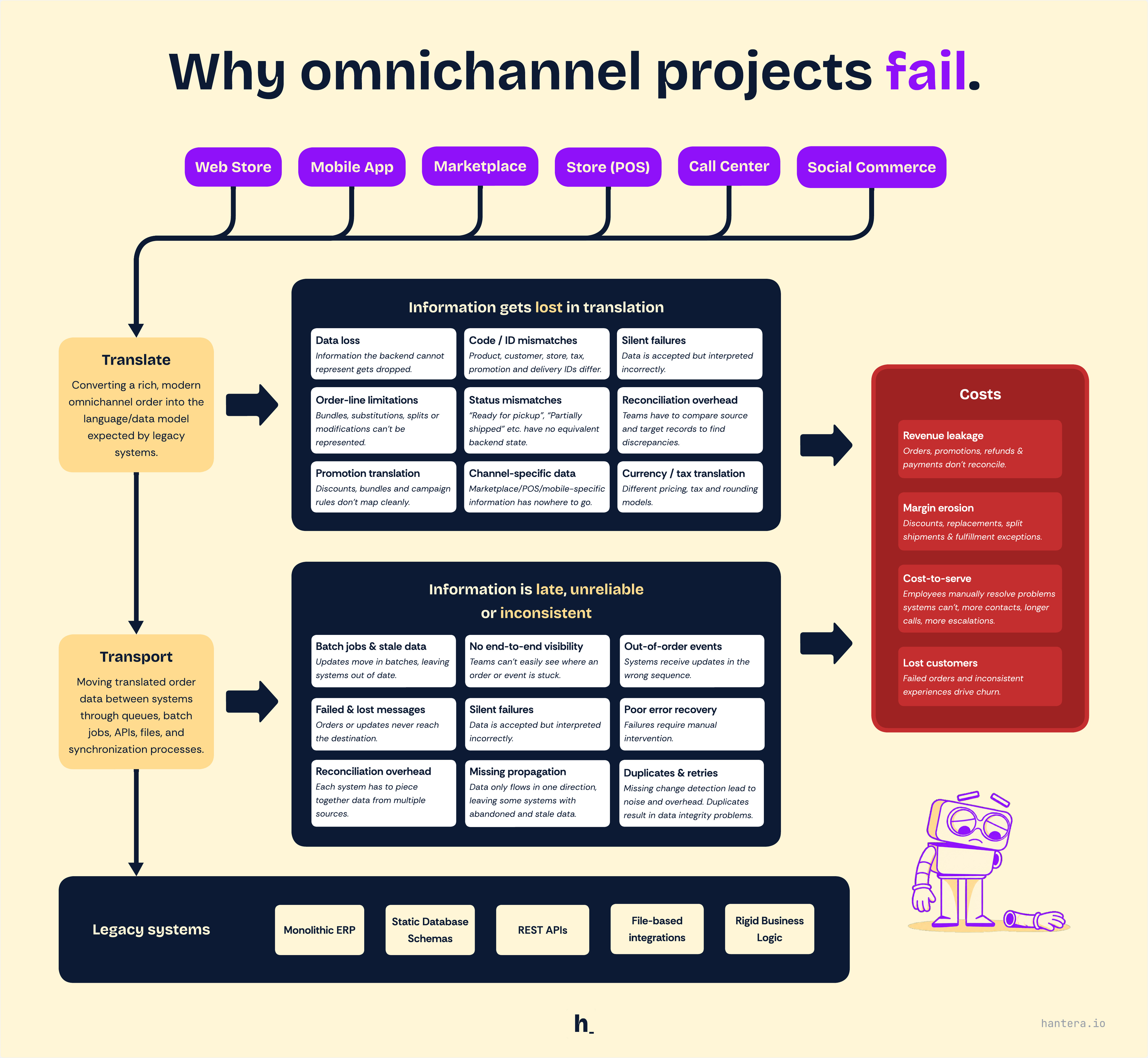
Failure Point A: Static Order Record Locks
Traditional ERPs and standard commerce engines often treat orders as relatively static records once they enter the fulfillment stage. In a scenario where a customer places a multi-line ship-from-store order, and one of the items gets damaged, it can be difficult to edit that item in the order record. A split dispatch from another store would also not be possible because the existing order model does not support the required change. The available legacy system option would be a forced full-order cancellation. This means the customer has to place the order again. Most of the time, they wouldn’t, and this can weaken customer loyalty and lead to churn.
Failure Point B: Cross-Channel Disconnect
When a customer buys online via BOPIS and calls support minutes later to change their pickup store or swap a variant, the support agent may not be able to access the latest order state. This is because legacy backend systems often rely on batch-synchronized data, so the web storefront, store POS, and customer support portal may be operating on different data sets.
Failure Point C: ERP Core Pollution
Basic e-commerce platforms alone can’t handle the complex routing required by omnichannel. When retailers attempt to code custom fulfillment rules, tax deltas, and split-shipment logic directly within their ERP’s financial and operational core, there is bound to be inaccurate data. These systems are not designed to act as the orchestration layer for constantly changing distributed fulfillment logic, and every minor change to shipping rules requires developer hours and risks affecting core accounting processes.
These failure points are a direct result of the engine driving post-checkout and fulfillment operations. An order orchestration engine plugged directly into these failure points fixes them.
How an Order Orchestration Engine Makes Omnichannel Actually Work
The order orchestration engine, as a core capability of a modern order management system, serves as an event-driven abstraction layer between front-end touchpoints and downstream fulfillment systems. These systems include ERPs, WMSs, 3PLs, and carrier APIs. While the front-ends emit customer intent, downstream systems record operational and accounting facts. The orchestration engine handles everything in between: dynamic inventory reservation, complex routing, split dispatches, and mid-flight order mutations. Here is how these capabilities make omnichannel work.
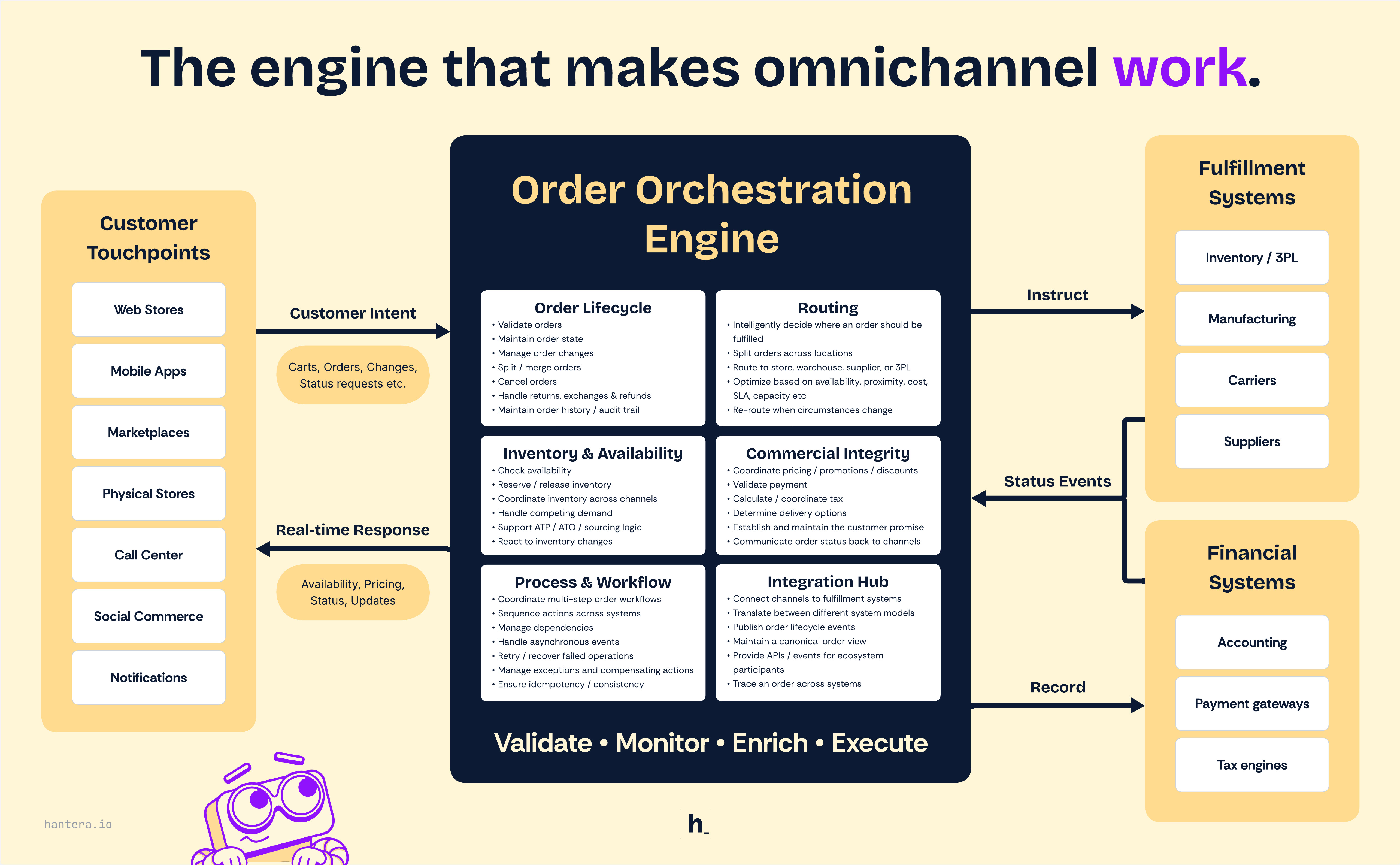
Living Order Containers
Rather than writing an order as a single immutable record to a database, the orchestration engine encapsulates each active order as an independent state machine with its own private state. The orchestrator responds to real-world events, such as address updates and variant swaps, by applying state transitions without destroying the parent order object. A customer or support rep can swap a size and change a pickup store location, while keeping the order number and customer context intact across all channels.
In-sync Financial Recalculation
Post-checkout order editing for a BOPIS order can cause split order pickups, where shipping a preferred order variant from a different fulfillment location can result in different tax calculations. The orchestration engine can automatically recalculate these changes and keep the order financially consistent across channels. It can run real-time delta calculations on localized sales taxes, store-specific promotional logic, and even gift card reconciliation. This prevents inaccurate accounting data and eliminates the need for manual ledger adjustments by finance teams.
Clean Core ERP Preservation
The order orchestration engine absorbs and applies all of the complex fulfillment rules, including proximity routing, store labor capacity thresholds, split-shipment rules, and even promotions. The ERP receives fully resolved financial data. Developer hours and the risk of these changes affecting core accounting processes are reduced.
Hantera is an example of a modern order management platform that implements this orchestration architecture. It combines an actor-based system, which isolates state to permit non-destructive order mutations, with an API-first Graph interface that allows front-end and support tools to traverse and query dynamic order data.
Implementing a successful omnichannel strategy
To build the right omnichannel retail strategy, these are the steps to follow:
- Unify your stock data across physical stores, warehouses, and 3PLs into a single real-time inventory view to eliminate phantom inventory.
- Introduce an orchestration layer between your checkout channels and backend systems.
- Decouple volatile fulfillment routing and tax deltas from your primary ERP so its core remains focused on its role as the financial system of record.
- Equip store associates and support agents with tools integrated with the orchestration layer to process mid-flight order changes without forcing full cancellations or refunds.
- Set up rules to automatically route orders to the best fulfillment node based on stock levels, shipping costs, and store labor capacity.
Frequently Asked Questions
What is the primary difference between omnichannel and multichannel retail?
Multichannel retail operates across several independent, siloed platforms, often requiring customers to restart their journey when switching channels. Omnichannel retail unifies data, inventory, and context across all platforms into a single continuous experience.
Why do traditional ERPs struggle with omnichannel fulfillment?
Legacy ERPs were designed primarily around batch-oriented processing and structured order records rather than real-time, event-driven order mutations across physical stores, 3PLs, and digital channels.
How does backend order orchestration reduce customer support costs?
By enabling non-destructive order edits across channels, orchestration allows self-service portals and support reps to adjust addresses, items, or delivery points in real time. This cuts handling times and eliminates forced cancellations.
Is omnichannel retail the same as omnichannel marketing?
No. Omnichannel marketing focuses on coordinating marketing activities and customer communications across channels such as email, social media, and SMS to deliver a unified message to customers. Omnichannel retail is broader on the operational side, connecting channels with shared customer data, inventory, orders, and fulfillment capabilities. The same distinction applies to multichannel marketing, which uses multiple marketing channels to reach customers, but those channels can operate independently without sharing the same customer context.
How does order management improve customer satisfaction in omnichannel retail?
Order management improves customer satisfaction by keeping order, inventory, and customer context synchronized across the communication channels customers use to interact with a retailer. This allows customers to move between channels, such as a website, mobile app, store POS, and customer service, without losing order context or having to repeat information. It also enables support agents and store associates to make mid-flight order changes without forcing customers to cancel and place a new order.