
Order management for everything after checkout.
The order is not finished when payment clears. It becomes the living context behind delivery, support, returns, refunds, tax, and recovery. Hantera_ keeps that context connected so teams can keep the customer promise.
What was promised
What actually happened
What Hantera_ does next
The order does not end at checkout. It starts waiting.
Most systems treat an order as finished once it is fulfilled. For the customer, that is the moment the waiting begins — and every step after it is another chance to keep or break the promise.
All of it belongs to the same order. Not a receipt that stops at payment, but a record that keeps changing — and shows what was promised, what happened instead, and what anyone is still able to do about it.
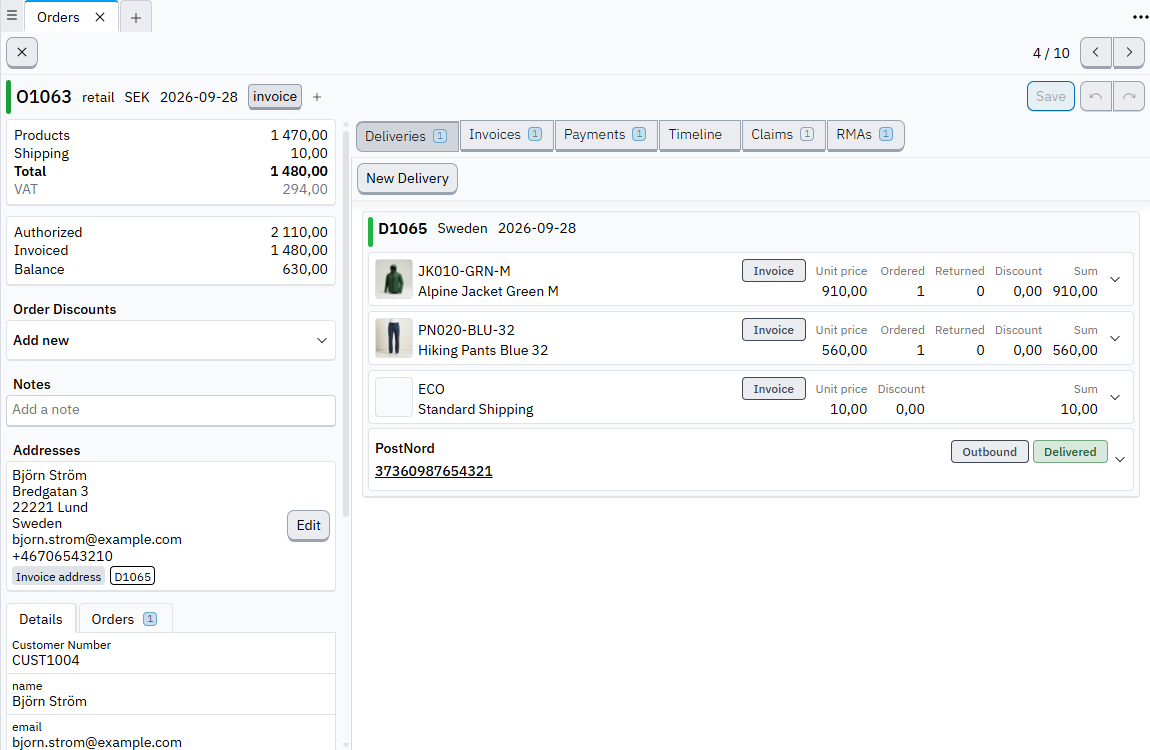
Fulfilled is not the same as finished.
One domain, four places it has to hold up.
Order management is not a single screen. It is the operational lifecycle of a commitment: what you promised, what you can actually deliver, what happens when that changes, and whether the money still adds up afterwards. Each area below has a page of its own.
Inventory & availability
Available-to-promise, reservations, allocations, back orders and the routing decision behind a delivery date you can stand behind.
Inventory & Availability →Returns & recovery
Claims, RMAs, inspections, recalls and the resolution — refund, replacement, exchange or compensation — applied back to the order.
Returns & Recovery →Payments & financial resolution
Invoices, payment history, capture, credits and refunds that stay connected to the order as fulfillment and returns change it.
Payments & Financial Resolution →Shipping & consignment tracking
Carrier events on the order, delays spotted before the customer asks, lost parcels resolved and compensation added after fulfillment.
Shipping & Consignment Tracking →Hantera_ is also the hub these areas meet in — see integrations and apps.
Every order is a stack of promises.
Price, the campaign they bought on, availability, delivery date, tax, return eligibility, refund timing, and the answer support gives when someone asks. When one of those fails, someone pays for it — first in the reshipment, the return transit, the goodwill discount and the afternoon it takes, and then in the margin from a customer who quietly never comes back.
The cost of a broken promise.
What it costs to put right
Return transit, a second shipment, restocking, the discount offered to smooth it over, and the team time spent working out what happened. None of it arrives on an invoice, so it rarely gets counted.
The margin that leaves with them
That order is already paid for. The loss is the contribution margin on every order the customer would have placed next — against an acquisition cost you pay again to replace them.
What recovery is worth
Most of that gap is recoverable. Prevent what you can see coming, and when something still breaks, give the team the context and the authority to make it right while the customer is still listening.
When the order changes, the next move should be clear.
A missed cut-off, an address change, a partial return or a stock shortfall should not start another round of calls, exports and guesswork. Hantera_ keeps the policy, the operational facts and the surrounding systems connected, so the response can happen while it still matters to the customer.
Rules make the response explicit
A rule reacts when something happens, weighs the order context that matters, then validates the change, applies an action or triggers the next step. The policy and the authority to act are part of the operation — not something support reconstructs afterwards.
Work keeps moving after the event
Some work happens now; some has to run later or in the background. Jobs carry the follow-up, the notification, the retry and the recovery step forward, so keeping the promise does not depend on someone remembering.
Systems receive the outcome, not a mystery
Reactors reach the systems around the order; ingresses give those systems a defined way back in. ERP, warehouse, payment, tax and help desk each get the resolved change through a named boundary instead of a thread through the core.
Market rules, customer agreements and partner-specific handling live in versioned apps — so adapting the operation never becomes the reason an upgrade is postponed.
The capabilities that carry the order further.
Commerce carries the campaign and checkout agreement into the order. Inventory Routing turns availability into a fulfillment decision. Returns adds the claim, inspection and recovery workflow around the same connected record.
Commerce
By Hantera_
Cart and promotion management, with a rendering pipeline that turns a basket into an order.
Official FulfillmentInventory Routing
By Hantera_
Assigns each delivery to a warehouse based on stock availability and country routing priorities.
Official FulfillmentReturns
By Hantera_
Customer claim and warehouse inspection workflows, with resolutions applied to the order.
OfficialShow us your post-sale flow.
We’ll show you where the order promise holds, where it breaks, and what it would take to keep it.